
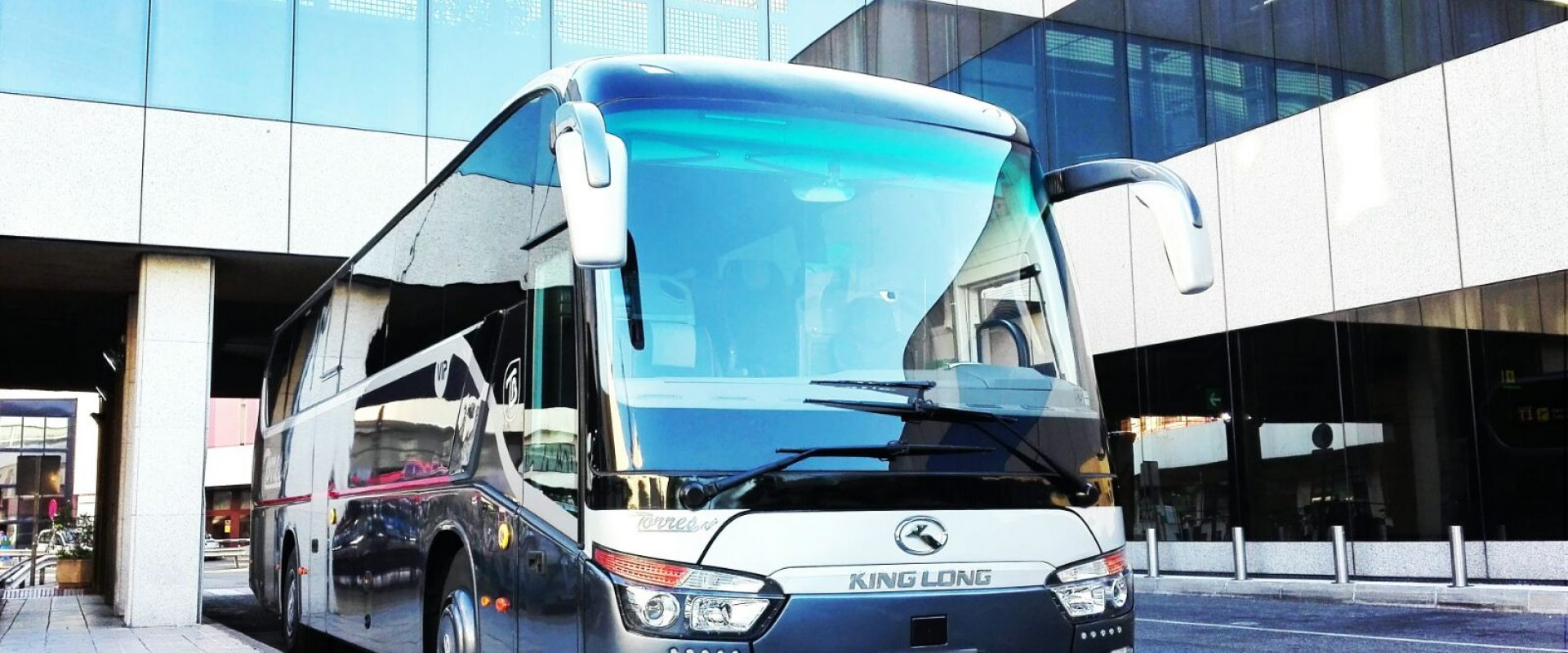
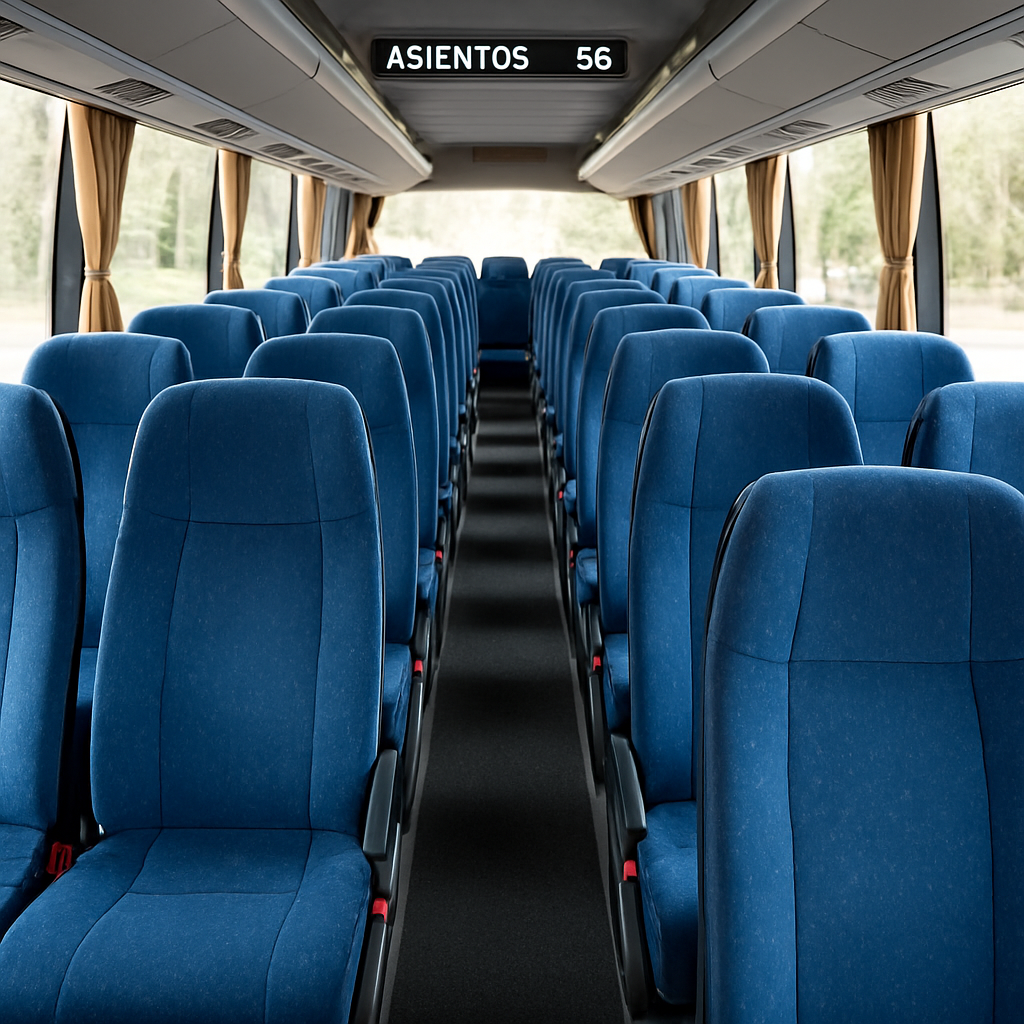
Ever looked at a coach bus and wondered exactly how many seats are hidden behind those rows of windows? You’re not alone – that question pops up every time an event planner, a tour operator, or even a family thinks about moving a group from point A to point B.
The short answer is that a typical coach can seat anywhere from 45 to 60 passengers, but the exact number depends on a handful of factors you might not think about at first glance.
First, the interior layout matters. A coach with a standard three‑plus‑two seat configuration will hold more people than one that trades a row for a small lounge or a wheelchair‑accessible space. Those extra comforts shave off a few seats, but they can be a lifesaver for groups that need accessibility.
Second, legal limits set by Spanish traffic regulations cap the passenger count based on the vehicle’s weight class and the number of emergency exits. In practice, most 12‑meter coaches we see in Madrid max out at 57 seats, while a slightly shorter 10‑meter model tops out around 45.
Third, the purpose of your trip can shift the configuration. A corporate roadshow often opts for a high‑density layout to keep costs down, while a wedding transport might request a more spacious arrangement with extra legroom and a mini‑bar for that VIP feel.
So how do you decide which coach size fits your group? Start by counting the heads – literally. Add one or two extra seats for the driver and any staff, then factor in any accessibility needs or special equipment. Once you have that number, you can match it to a bus class: 45‑seat, 50‑seat, or 57‑seat models are the most common in our fleet.
And remember, a slightly larger coach isn’t always better – extra seats mean higher fuel costs and less room to move around. Pick the size that feels comfortable for everyone, and you’ll arrive at your destination relaxed and ready to enjoy the event.
TL;DR
Wondering how many seats a coach bus can hold? In Spain you’ll typically find 45‑ to 57‑seat coaches, with layout, legal limits, trip purpose, and added driver or accessibility equipment shaping the exact capacity.
Pick the size that fits your group for comfort and cost‑efficiency, and always double‑check the final seat count before you book.
Understanding Coach Bus Size Categories
Ever stared at a blank bus floor plan and wondered which size actually fits your group? You’re not alone – the numbers can feel a bit mysterious until you break them down.
Why size matters
In Spain we mostly see three sweet‑spot categories: a 45‑seat coach, a 50‑seat model, and the larger 57‑seat version that tops out most 12‑meter fleets. Some operators even run 70‑seat luxury coaches for big corporate shuttles, but those are the exception rather than the rule.
Choosing the right bucket is more than just “fit the heads.” A tighter layout saves fuel, while a roomier cabin means more legroom, maybe a mini‑bar for a wedding, or space for a wheelchair‑accessible module.
If you want the full low‑down on every configuration, our How Many Seats on a Coach Bus: Complete Guide walks you through every seat map.
Legal and physical constraints
Spanish traffic law caps passenger numbers based on vehicle weight class and the number of emergency exits. A 10‑meter coach can’t legally carry more than 45 seats because the doors and windows must meet evacuation standards. Step up to a 12‑meter chassis, and you unlock up to 57 seats – provided the bus has two side exits and a rear door.
Those limits also dictate where the driver sits. In many of our VIP setups, we add a dedicated “coach captain” seat for a second driver on long hauls, which nudges the total headcount up by one.
Practical examples you’ll recognise
Imagine you’re planning a corporate roadshow in Madrid. You’ve got 48 employees, a few laptops, and a speaker who wants a small podium. The 50‑seat coach gives you that extra cushion without sacrificing comfort – and you can still slip in a portable Wi‑Fi router.
Now picture a wedding party of 30 guests plus the bridal party. You might choose a 45‑seat coach and ask us to remove a row for a mini‑lounge, turning a regular seat into a cosy spot for the couple’s first dance on wheels.
For school trips, the rule of thumb is to leave a seat empty for every ten students – that way the teacher can move around safely. A 57‑seat coach works well for a 50‑student field trip, leaving room for chaperones and a small medical kit.
Event planners often need printed seat maps, tickets, or itineraries to hand out. That’s where custom printed seat maps and itineraries become a lifesaver – you can hand out a clear visual so everyone knows where they’re sitting before the bus doors close.
Special needs and extra equipment
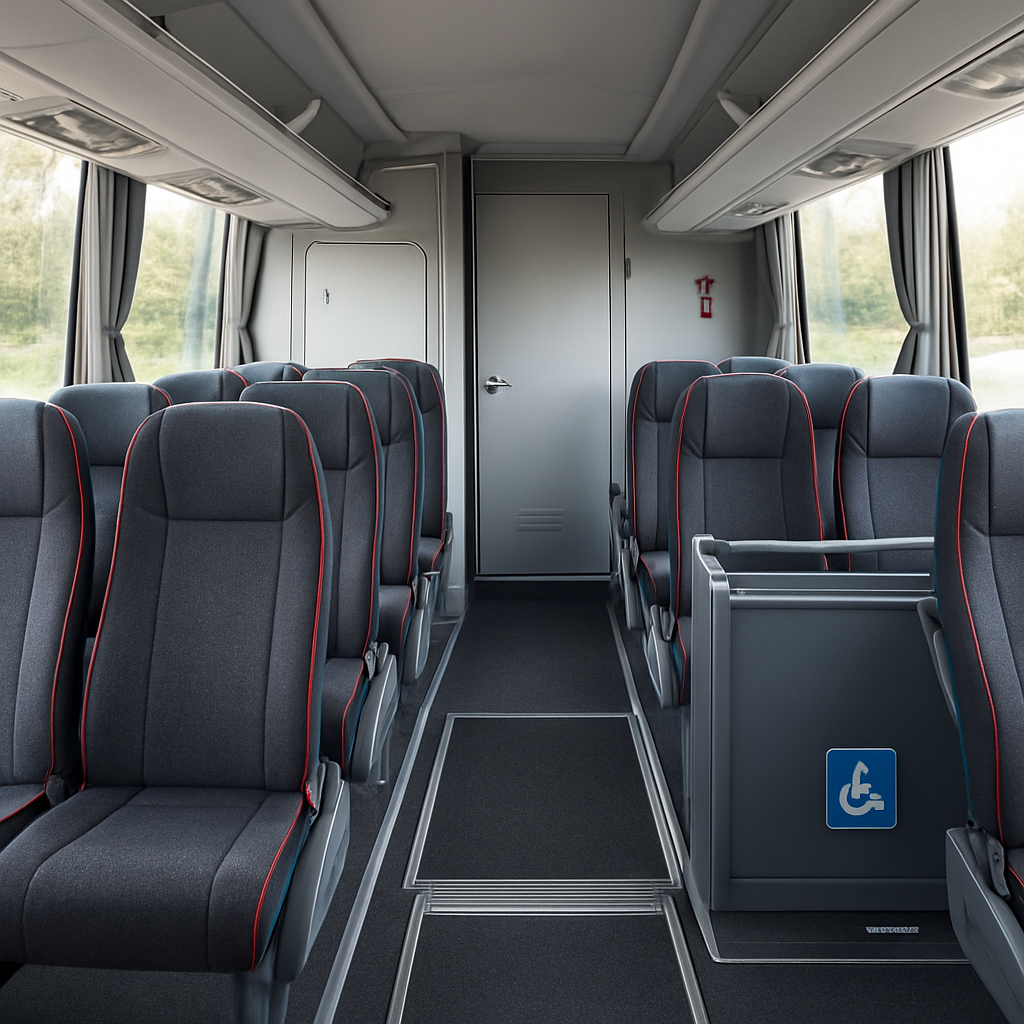
Accessibility isn’t an afterthought. A PMR‑adapted coach swaps a row of seats for a wheelchair ramp and securing points. That usually drops the total capacity by three or four seats, but the trade‑off is worth it for compliance and comfort.
If you’re hauling a live band or a troupe of Cuban musicians for a festival, you’ll need space for instruments and possibly a small stage area. Check out live Cuban music artists in Madrid – they often travel with gear that requires a bit of extra room, and we can match the bus size to that need.
Seeing the layout in action helps a lot. Below is a quick video that walks you through a typical 57‑seat interior, highlighting where you can add or remove rows.
Notice how the aisle width stays consistent even when a row is removed for a wheelchair lift – that’s the design rule we follow to keep everything safe and comfortable.

Bottom line: match the category to your group size, legal limits, and any extra equipment you need. When you’re unsure, start with the 50‑seat model – it’s the sweet spot for most events and leaves room for a few surprises.
How Seat Layout Affects Capacity
Ever walked into a coach and felt a little lost wondering how many seats actually fit inside? You’re not alone – the layout is the silent game‑changer behind the headline number you hear when you ask, “how many seats in a coach bus?”
First thing to notice is the aisle width. A wider aisle feels roomy, but every extra inch you give to the walkway is an inch you lose from a seat column. That’s why a 3‑plus‑2 layout (three seats on the aisle side, two by the window) squeezes in 57 seats on a 12‑meter coach, while a 2‑plus‑2 set‑up on a shorter 10‑meter bus tops out at 45.
Seat pitch and legroom
Seat pitch – the distance from one seat back to the next – usually runs between 28 and 34 inches. If you opt for a luxury feel with 34‑inch pitch, you’ll shave off a few rows compared to a tighter 28‑inch configuration. For a corporate roadshow where you need every seat, you might pick the tighter pitch; for a wedding shuttle where comfort matters, you’ll likely choose the extra legroom, even if it drops the count to 50.
Think about it this way: imagine two groups of 50 guests. One group rides a coach with tighter pitch and gets a few extra seats, but everyone’s knees are cramped on a four‑hour trip. The other group travels on a coach with a bit more space, ends up with a couple of empty spots, but arrives feeling refreshed. Which scenario feels like a win?
Onboard amenities that eat seats
Restrooms, galleys, and wheelchair bays are the silent seat‑stealers. Adding a compact restroom can knock off two to four seats, and a wheelchair lift might remove three more. That’s why you’ll see a 57‑seat coach lose a handful of seats when it’s equipped for reduced‑mobility passengers. In our experience, planning for accessibility early prevents last‑minute seat shuffling.
Even something as simple as a luggage compartment under the seats can affect capacity. If you’re moving a sports team with gear, you might need to reserve a larger cargo bay, which could mean losing a row of seats.
Configuration examples for common events
- Corporate conference (45‑55 people): Choose a 2‑plus‑3 layout with 30‑inch pitch. You keep the aisle wide enough for easy movement, and you still hit the sweet spot of 50 seats.
- Wedding transport (30‑40 guests): Go for a 3‑plus‑2 layout with 34‑inch pitch and a small restroom. You’ll end up with about 44 seats, leaving room for a bridal party that wants to stretch out.
- School field trip (up to 45 students): A 2‑plus‑2 layout with 28‑inch pitch maximizes seats while keeping aisles clear for chaperones and wheelchair access.
Notice the pattern? The “how many seats in a coach bus” answer shifts as you juggle aisle width, seat pitch, and added features.
Quick checklist when you compare layouts
Before you sign off on a quote, run through these points:
- Ask the operator for a seat map and confirm aisle width – aim for at least 22 inches for wheelchair access.
- Verify seat pitch; subtract one row for every 2‑inch increase in pitch if you need more legroom.
- Identify any amenities (restroom, galley, wheelchair lift) and ask how many seats they remove.
- Calculate luggage volume per passenger; if it’s high, consider a larger cargo bay and reduce seat count accordingly.
When you line up those numbers, the mystery behind the coach’s capacity clears up.
One thing we often see in the field is planners overlooking the impact of a single extra aisle column. Adding a second aisle can make boarding faster for a large group, but it also chops off an entire seat column, dropping a 57‑seat coach down to about 48 seats. It’s a trade‑off you’ll want to weigh against your schedule.
And remember, the legal limit set by Spanish traffic regulations caps the passenger count based on vehicle length and weight class. Even if you can physically squeeze 60 seats into a 12‑meter coach, the law might only allow 57. Always ask for the certified seating capacity, not just the “theoretical” number.
So, what’s the takeaway? The raw seat count is just the starting point. The actual number you can comfortably and legally use depends on the layout choices you make – aisle width, seat pitch, and any onboard amenities. By mapping out those variables early, you avoid surprises on the day of the event and ensure every passenger has a seat that feels right for the journey.
For a broader view of how seat counts vary across different bus types, you can check out a helpful guide on charter bus capacity ranges. It breaks down the same factors we’ve discussed, but from a U.S. perspective – the principles are universal.
Calculating Seats: Step‑by‑Step Method
Ever stared at a blank seat map and thought, “How many seats in a coach bus do we actually have for my wedding crew?” You’re not alone – that moment of doubt is the first clue that you need a solid method, not a guess.
So, what if I told you there’s a simple, repeatable process you can run on a napkin or in a spreadsheet? No magic calculator, just a few questions and a bit of math. Let’s walk through it together.
Step 1 – Count every person who will be on board
Start with the obvious: the guests, the staff, the driver, and any extra crew (like a photographer or a tour guide). Write them down in a column. It’s easy to forget the driver’s assistant or a wheelchair attendant, but they occupy a seat just the same.
Step 2 – Choose your base layout
Pick the configuration you’re most likely to use – 3‑plus‑2, 2‑plus‑3, or a 2‑plus‑2 “compact” setup. In Spain a 57‑seat coach usually follows a 3‑plus‑2 pattern, while a 45‑seat model sticks to 2‑plus‑2. If you’re not sure, a quick glance at a typical coach diagram shows that a standard coach bus typically seats between 47 and 57 passengers according to industry data. Write that number down as your starting point.
Step 3 – Adjust for seat pitch
Every extra inch of legroom you add knocks off roughly one row. For example, moving from a 30‑inch pitch to a 34‑inch pitch on a 57‑seat coach will shave off about two rows, leaving you with roughly 51 usable seats. If you prefer a tighter 28‑inch pitch, you’ll keep the full 57.
Step 4 – Subtract amenities
Restrooms, a small galley, or a wheelchair bay each steal seats. A compact restroom usually removes 2‑4 seats; a wheelchair lift can take another three. Write a quick checklist:
- Restroom? – – 3 seats
- Wheelchair bay? – – 3 seats
- On‑board entertainment unit? – – 1 seat
Subtract the total from your base number.
Step 5 – Factor in legal limits
Spanish traffic regulations cap the passenger count based on vehicle length and weight class. Even if you can physically fit 60 seats in a 12‑meter coach, the law may only allow 57. A quick way to verify is to ask your operator for the certified capacity – it’s the number you must stay under.
Step 6 – Run the quick math
Now add up:
Total people (Step 1) + Driver + Assistant = Required seats.
Base seats (Step 2) – Pitch loss (Step 3) – Amenity loss (Step 4) = Available seats.
If Required ≤ Available, you’re good. If not, go back and tweak pitch or drop an amenity.
Step 7 – Validate with a cost calculator
Many charter firms let you plug those numbers into an online estimator. For instance, US Coachways offers a free cost calculator where you can input group size and layout to see how seat count and price align here. It won’t give you a legal certification, but it’s a handy sanity check before you call your provider.
Step 8 – Confirm with the operator
Before you sign the contract, ask for a detailed seat map that marks aisle width, wheelchair clearance, and emergency‑exit placement. A quick photo of the actual interior can save you from a surprise on the day of the event.
And that’s it – eight straightforward steps that turn “how many seats in a coach bus?” from a vague question into a concrete answer you can trust. Grab a pen, sketch that layout, and you’ll walk into the booking call with confidence.
Comparison of Common Coach Bus Configurations
Why configuration matters
When you’re juggling a wedding shuttle, a school field trip, or a corporate roadshow, the layout of the coach can feel like the secret sauce. A few extra seats can shave costs, but it might also squeeze legroom or block a wheelchair ramp.
So, which configuration gives you the sweet spot between capacity, comfort, and compliance? Let’s walk through the three workhorses you’ll see on Spanish roads.
Seat‑count basics
2‑plus‑2 – the compact, 45‑seat workhorse. It’s a straight‑forward two‑seat aisle on each side, perfect for tight city streets and venues where you need a smaller footprint.
Imagine you’re moving a group of 38 school kids plus a driver and a chaperone. That 45‑seat coach slides into a narrow loading bay without a fuss.
2‑plus‑3 – the middle‑ground, usually 50 seats. Adding an extra seat on the window side bumps capacity while keeping the aisle wide enough for easy boarding.
Think of a regional conference where you expect around 48 attendees. The 2‑plus‑3 layout lets you fit everyone without turning the bus into a sardine can.
3‑plus‑2 – the full‑size, 57‑seat giant. Three seats by the aisle, two by the window, maxing out the legal passenger limit for most Spanish coaches.
Picture a music festival pulling 300 fans onto four buses. Those 57‑seat rigs cut the number of trips you need, saving fuel and time.
But here’s the kicker: more seats often mean less room for amenities. A restroom, a small galley, or a wheelchair bay can chip away five to eight seats, regardless of the base layout.
Real‑world trade‑offs
If you need a wheelchair‑accessible space, you’ll lose about three seats no matter the configuration. That’s why many operators offer a “flex” version of the 3‑plus‑2 with a removable row to create a ramp area.
And legroom matters, too. A 30‑inch pitch feels comfortable on a 3‑hour trip; a 34‑inch pitch feels luxurious on a 6‑hour journey, but each extra inch can shave one or two rows off the total seat count.
So, what should you do next? Match the configuration to the event’s vibe, the passengers’ needs, and any special equipment you must carry.
Quick comparison table
| Configuration | Typical Seats (Spain) | Ideal Use Cases | Main Trade‑offs |
|---|---|---|---|
| 2‑plus‑2 | 45 | Urban shuttles, tight loading zones, small groups (30‑40 pax) | Limited capacity, less room for extra amenities |
| 2‑plus‑3 | 50 | Mid‑size corporate trips, school outings (45‑55 pax) | Balancing aisle width with added seat; modest impact on legroom |
| 3‑plus‑2 | 57 | Large events, intercity tours, festival transport (55‑65 pax) | Requires careful planning for wheelchair or restroom space; tighter aisle |
In practice, I’ve seen event planners start with the 2‑plus‑3 layout for a corporate retreat, then ask the operator to drop a row when a wheelchair passenger joins. The result? A comfortable ride and full compliance with Spanish accessibility regulations.
Does this really help you decide? Absolutely. Grab a pen, sketch a quick seat map of the layout you’re leaning toward, and flag any rows you might need to sacrifice for a restroom or ramp.
When you’re ready, call your coach provider (like Torres Bus) and confirm the exact seat count after amenities are factored in. That final number is the one you’ll use for budgeting, safety checks, and, of course, making sure every guest has a seat.
For a deeper dive into official capacity numbers and legal limits, check out the official capacity guidelines that many European operators reference.
Factors That Can Increase or Decrease Seat Count
When you start asking yourself how many seats in a coach bus you quickly discover that the answer isn’t a static number. It’s a moving target shaped by everything you put inside the vehicle and everything you take out.
First thing most planners overlook is the ripple effect of a single amenity. A compact restroom might look harmless, but it usually eats two to four seats. A wheelchair bay can shave off another three. Those numbers add up fast, especially on a 57‑seat 3‑plus‑2 layout.
Seat pitch – the silent seat‑stealer
Seat pitch is the distance from one seat back to the next. The tighter you go (28‑inch pitch), the more rows you can squeeze in. Bump that up to 34‑inch for a luxury feel and you’ll lose roughly one row per 2‑inch increase. In practice, a 57‑seat coach with a 34‑inch pitch might end up with about 51 usable seats.
That trade‑off shows up in real life all the time. I’ve seen a corporate roadshow in Valencia start with a 57‑seat coach, then ask us to add extra legroom for a 4‑hour journey. The final seat count dropped to 52, but the client told us the crew arrived refreshed and actually more productive.
Layout choices and aisle width
Three common layouts dominate Spanish coach fleets: 2‑plus‑2 (45 seats), 2‑plus‑3 (≈50 seats) and 3‑plus‑2 (≈57 seats). Each adds a column of seats, but also determines how wide the aisle can be. A wider aisle is great for wheelchair access, but every extra inch you give to the walkway costs a seat column somewhere else.
Imagine you’re planning a school field trip with a few mobility‑impaired students. You might start with a 3‑plus‑2 layout, then ask the operator to drop a row and install a ramp. The result is a 54‑seat bus that still complies with Spanish traffic regulations.
Onboard amenities that nibble seats
Beyond restrooms and ramps, think about galley units, entertainment screens, or even a small coffee bar. A typical mini‑galley can take away another two seats. If you need Wi‑Fi routers and power outlets for a tech‑heavy conference, those installations often occupy the space under the seats, effectively reducing the count by one or two.
One source notes that a full‑size coach can seat up to 56 passengers when you factor in standard amenities like overhead storage and climate control (see Voigt’s comparison of coach versus mini‑bus capacity). That figure already assumes a basic restroom and a modest luggage bay – anything extra will push the number down.
Legal limits – the non‑negotiable ceiling
Spanish traffic regulations cap the passenger count based on vehicle length and weight class. Even if you can physically squeeze 60 seats into a 12‑meter coach, the law may only allow 57. Always ask the operator for the certified capacity; that’s the number you must stay under.
And don’t forget the driver and any assistant. They count as seats too, even if you don’t plan on them being occupied by passengers.
Quick checklist for seat‑count sanity
- Identify base layout (2‑plus‑2, 2‑plus‑3, 3‑plus‑2).
- Decide on seat pitch – tighter for max seats, looser for comfort.
- List required amenities (restroom, wheelchair bay, galley, Wi‑Fi).
- Subtract seats per amenity (≈2‑4 per restroom, ≈3 for wheelchair bay, ≈2 for galley).
- Confirm legal certified capacity with the operator.
- Add driver and any crew to the total.
Run through that list on a napkin, and you’ll instantly see whether you need to drop a row, choose a larger coach, or maybe even split the group into two buses.
So, what should you do next? Sketch a simple seat map, flag the spots you’ll lose to amenities, and call your coach provider – like Torres Bus – to lock in the exact number. That final count becomes the backbone of your budget, your safety plan, and ultimately, the comfort of every passenger.
Remember, the goal isn’t just to fill every seat; it’s to fill them with happy, rested travelers who can enjoy the journey as much as the destination.
Conclusion
So, after digging through layouts, seat pitches, and those little amenity eat‑ers, what’s the bottom line on how many seats in a coach bus you can actually count on?
In short, the headline range of 45‑57 seats is just the starting point. Your final number hinges on three things: the base configuration (2‑plus‑2, 2‑plus‑3 or 3‑plus‑2), the legroom you choose, and any onboard features like a restroom or wheelchair ramp. Each extra inch of pitch can shave off a row, and every restroom typically knocks out two to four seats.
What does that mean for you, whether you’re planning a wedding shuttle, a corporate roadshow, or a school field trip? Start by sketching a simple seat map, flag the rows you’ll lose to amenities, and then run the quick checklist we’ve been using: layout → pitch → amenities → legal certified capacity → driver + crew.
If the math still looks tight, consider swapping a 57‑seat rig for a 50‑seat model with a bit more legroom – you’ll often save on fuel and keep passengers comfortable. And remember, the driver and any assistant always count as seats too.
Finally, give your coach provider – like Torres Bus – a call with your sketched map. A quick confirmation of the certified seat count will lock in your budget, safety plan, and peace of mind.
Now you’ve got a clear roadmap. You know exactly how many seats in a coach bus fit your group, and you have a concrete next step to make that trip run smoothly.
FAQ
How many seats does a typical coach bus have in Spain?
Most coach buses you’ll see on Spanish highways fall into three size families: 45‑seat, 50‑seat and 57‑seat. The 45‑seat rigs are usually 10 m long with a 2‑plus‑2 layout, the 50‑seat models are about 11 m and use a 2‑plus‑3 configuration, and the biggest 57‑seat coaches are 12 m long with a 3‑plus‑2 arrangement. The exact number can drop a few seats if you add a restroom or wheelchair ramp.
Can I fit a wheelchair on a coach bus without losing too many seats?
Yes, you can, but you’ll need to carve out a small bay that typically removes three to four passenger seats. Most operators, including us, install a fold‑down ramp or a lift in the middle aisle, and the surrounding seats are either removed or shifted to keep aisle width at the legal 22 inches. The trade‑off is worth it for accessibility and it keeps the bus compliant with Spanish traffic rules.
How does seat pitch affect the total seat count?
Seat pitch is the distance from the back of one seat to the back of the next. In Spain most coaches offer 28‑inch to 34‑inch pitch. Every two‑inch increase usually knocks off one whole row – that’s roughly two to three seats on a 57‑seat coach. If you need extra legroom for a four‑hour corporate roadshow, expect the count to fall to the low‑50s, which still feels comfortable.
Do driver and assistant seats count toward the total capacity?
Absolutely – the driver always occupies one of the certified seats, and if you add an assistant, a tour guide, or a wheelchair attendant they take another spot. When you calculate your headcount, add two extra seats to the passenger total. That small detail can be the difference between fitting everyone on a 50‑seat bus or having to move up to a 57‑seat model.
What legal limits should I be aware of when planning a coach bus trip in Spain?
Spanish traffic regulations cap the passenger count based on the vehicle’s length and weight class. A 10‑meter coach can’t legally carry more than 45 people, an 11‑meter unit tops out at 50, and a 12‑meter coach is limited to 57 seats, driver included. Those numbers already assume a standard layout without extra amenities, so always ask the operator for the certified capacity before you sign a contract.
How can I quickly verify the exact seat count for my event?
The fastest way is to request a detailed seat map from the coach provider. Most operators will email you a PDF showing each row, the aisle width and any removed seats for restrooms or wheelchair bays. Cross‑check that map with your own headcount checklist – driver, assistant, passengers, plus any extra gear. If the numbers line up, you’ve got a green light; if not, ask for a row to be added or removed.