
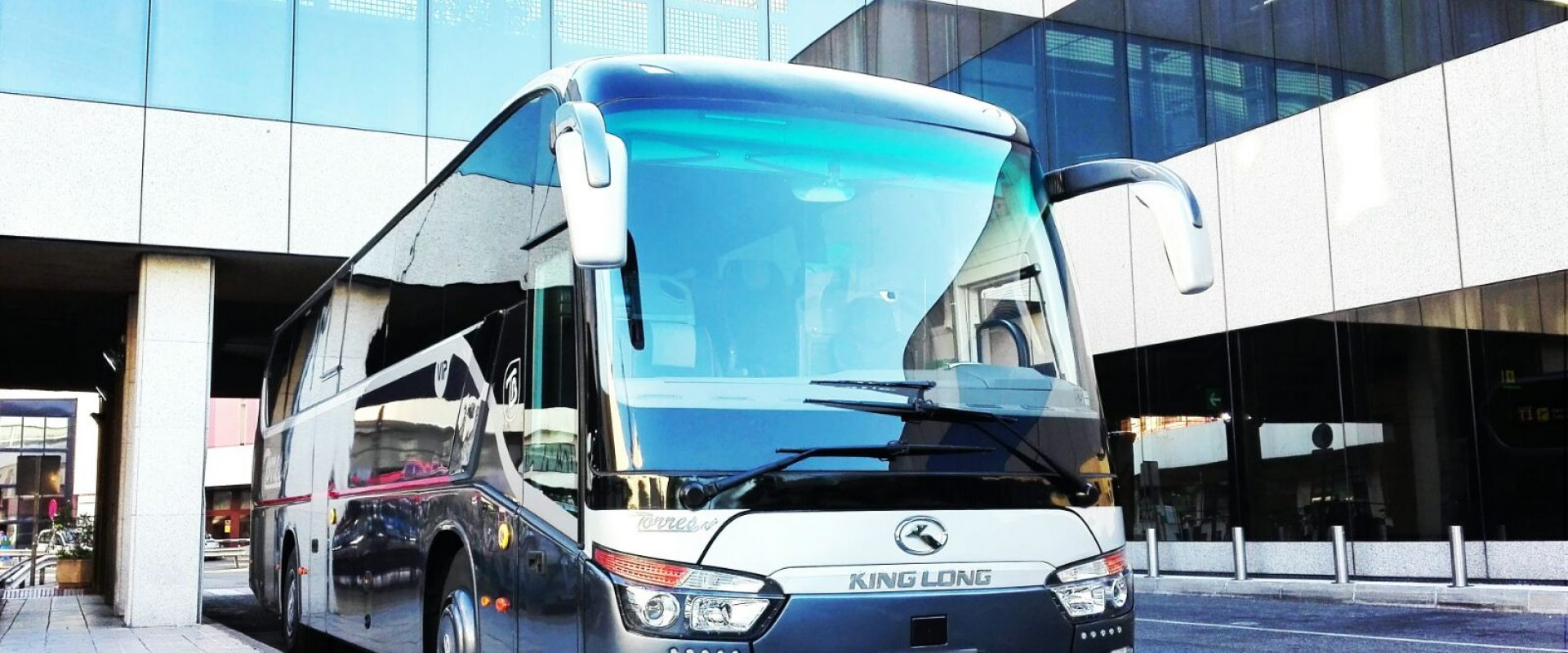
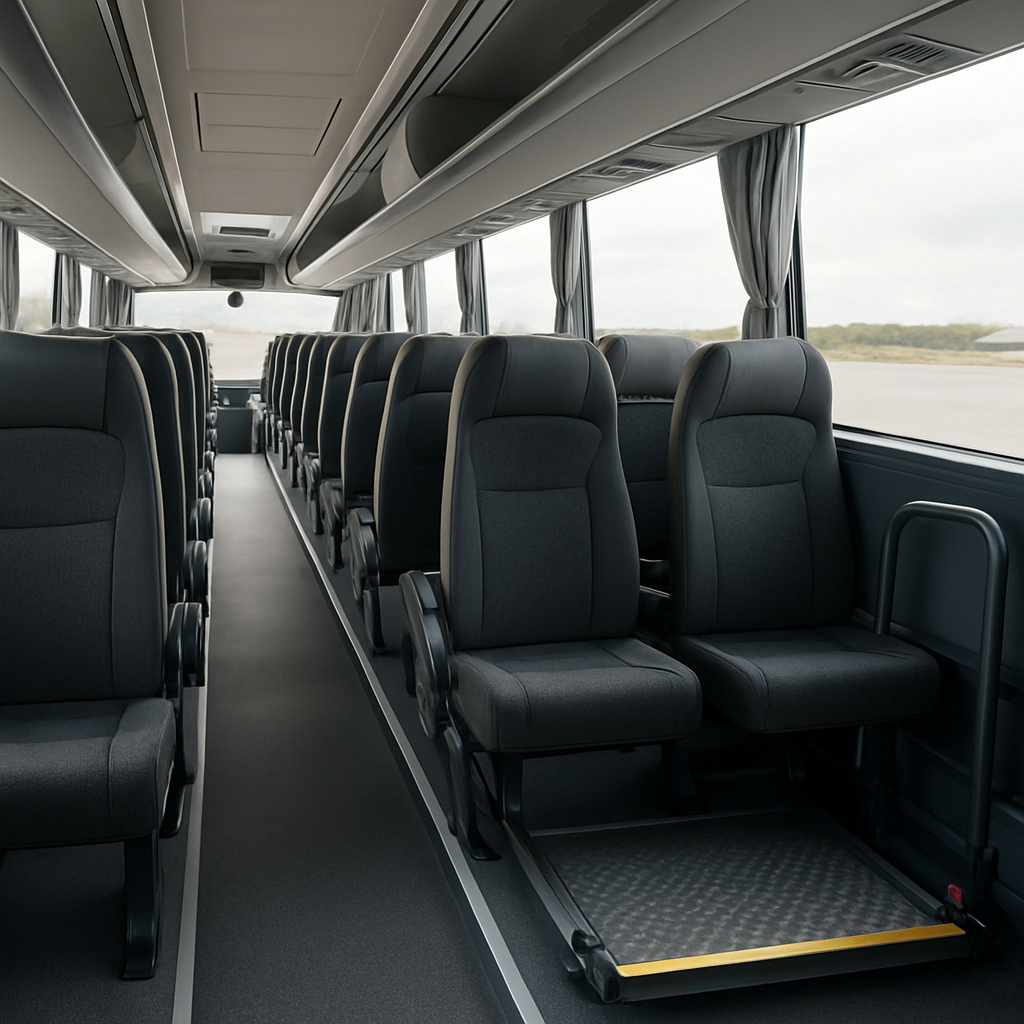
Ever stared at a blank charter bus and wondered how many seats does a charter bus have, especially when you’re juggling a wedding guest list or a corporate roadshow?
You’re not alone – we’ve seen event planners scramble for the perfect capacity, tour operators double‑check numbers before a day trip to Toledo, and even film crews trying to fit crew and gear in one ride.
The truth is, charter buses aren’t one‑size‑fits‑all. They range from cozy 12‑seat mini‑coaches that feel more like a premium van, all the way up to massive 70‑seat coaches that can haul a whole sports team and their equipment.
In Spain, the most common sizes you’ll encounter are 16, 25, 35, 45 and 55 seats – each size designed to meet specific regulatory limits and road‑type considerations.
If you’re planning a VIP airport transfer for a handful of executives, a 16‑seat mini‑bus gives you that intimate, plush feel while still offering enough room for luggage.
For a school field trip to a museum, a 35‑seat coach hits the sweet spot: enough seats to keep chaperones manageable, but not so big that you waste fuel.
And when you’re handling a concert crew of 60 plus gear, the 70‑seat coach becomes the workhorse – it’s built to handle weight limits, wheelchair ramps, and even on‑board restrooms.
What matters most isn’t just the number on the door; it’s how the layout matches your group’s needs – aisle width, seat recline, luggage compartments, and accessibility features.
That’s why we always start by mapping out who’s riding, what they’re bringing, and where you’re going. Once you have that picture, picking the right capacity is a breeze.
In the next sections we’ll break down each size, show you how to calculate the perfect fit, and share tips to avoid the dreaded ‘seat‑shortage’ nightmare that can derail any event.
TL;DR
Charter buses come in sizes from 7‑seat minibuses up to 70‑seat coaches, each designed for different group sizes, luggage and accessibility.
Pick the right seat count for your wedding, corporate roadshow, or school trip, and you’ll dodge seat‑shortage nightmares while keeping comfort high and budget overall, keeping everyone still happy.
Understanding Charter Bus Size Categories
Ever stared at a blank coach and thought, «How many seats does a charter bus have?» – you’re not alone. The first thing we do at Torres Bus is match the number on the door to the real‑world vibe of your group.
Let’s break it down. In Spain you’ll most often see five sweet‑spot categories: 16‑seat minibuses, 25‑seat mid‑size coaches, 35‑seat standard coaches, 45‑seat larger coaches, and the heavyweight 55‑ or 70‑seat coaches. Each bracket isn’t just a number; it tells a story about aisle width, luggage space, and the kind of comfort your passengers will feel.
Mini‑bus (7‑16 seats)
Think VIP airport transfer for a handful of executives, or a wedding party that wants to arrive together in style. These vehicles feel more like a plush van – you can actually hear the conversation over the hum of the engine. Because they’re compact, you get extra room for luggage racks and even a small wheelchair ramp if you need PMR‑adapted access.
Mid‑size coach (25‑35 seats)
Perfect for day‑trip tours – say a school outing to Segovia or a corporate team‑building day in Toledo. You get a decent aisle, a couple of overhead bins, and usually a mini‑restroom tucked at the rear. The 25‑seat model is great when you have a tight budget but still need that coach feel.
Here’s a tip: count not just the passengers, but also the suitcases. A 25‑seat coach typically offers about 2.5 m³ of cargo space – enough for a few large suitcases per person, but you’ll feel the squeeze if you’re hauling sport gear.
Standard coach (45‑55 seats)
When you’re moving a concert crew, a sports team, or a multi‑day conference group, the 45‑seat coach hits the sweet spot. The extra rows give you a full‑height restroom, a small kitchenette, and a wider aisle that makes wheelchair access smoother.
In our experience, a 55‑seat coach is the go‑to for national tours across Spain because it balances fuel efficiency with enough room for on‑board entertainment systems – perfect for keeping passengers happy on those long Madrid‑Barcelona hauls.
Full‑size coach (70 seats)
If you’re planning a festival crew of 60‑plus plus gear, you need the heavyweight. The 70‑seat coach is built for maximum load: reinforced suspension, multiple luggage compartments, and a larger restroom that can handle quick turnarounds.
But remember, more seats mean more weight, so fuel costs climb. That’s why we always run a quick cost‑per‑seat calculator before you sign off.
So, how do you decide which category fits your event? Start with a simple spreadsheet: list every attendee, note any special mobility needs, and add an extra slot for every two pieces of large luggage. Then match that total to the nearest size category – a little wiggle room never hurts.
And if you’re still unsure, think about the vibe you want. A 16‑seat mini‑bus screams exclusivity, while a 70‑seat coach shouts “we’ve got this covered, no matter the crowd.”
One last thing: always double‑check local regulations. Spain caps passenger numbers based on vehicle length and weight, so a 45‑seat coach can’t legally carry 50 people even if you squeeze them in.
Bottom line? Knowing the size categories turns the vague question “how many seats does a charter bus have?” into a clear, actionable plan that saves you money, avoids last‑minute scramble, and keeps everyone smiling from boarding to drop‑off.
Step 1: Identify Your Group Size and Travel Needs
First thing’s first: before you even ask “how many seats does a charter bus have,” you need a crystal‑clear picture of who’s riding and why they’re riding. It sounds obvious, but we’ve seen planners scramble because they started with the bus instead of the people.
When you know the emotional stakes – a nervous bride’s family, a sales team eager to close a deal, or a school crew excited for a field trip – you can match the bus size to the vibe, not the opposite.
Gather Your Guest List
Pull together every name, role, and contact detail. A simple spreadsheet works wonders: column A for name, B for “adult/child,” C for “VIP or staff,” D for “special needs.”
Real‑world example: Maria, an event planner in Madrid, was organizing a wedding with 68 guests. She listed 58 adults, 8 teenagers, and 2 grandparents who use a wheelchair. By separating the groups, she could see she needed a 70‑seat coach plus a mini‑bus for the wheelchair‑friendly space.
Another case: a tech firm in Barcelona booked a 45‑seat coach for a product launch. Their list showed 38 employees, 4 media reps, and 3 demo‑equipment crates. Knowing the exact headcount helped them avoid the last‑minute seat‑shortage panic.
Count Luggage and Gear
Every passenger usually brings 1‑2 pieces of luggage. Industry data suggests an average of 1.4 bags per person for a day‑trip and 2‑3 for overnight stays. Multiply that by your headcount, then add a 10 % buffer for unexpected parcels.
For a sports team heading to a tournament, each athlete might carry a backpack plus a pair of boots. If the squad has 22 players, you’re looking at roughly 60‑70 pieces of gear, which can eat up the under‑floor storage of a 45‑seat coach.
That’s why we always ask clients to list every suitcase, musical instrument, or camera rig. It turns a vague “lots of gear” into a concrete cubic‑meter figure you can match to a bus’s cargo volume.
Map Out Special Requirements
Accessibility isn’t an afterthought. A wheelchair‑friendly ramp typically removes 3‑5 seats from the total count, and you’ll need securement points for the chair.
Consider a pilgrimage group traveling from Santiago de Compostela to Madrid. Two participants need wheelchair access, so the planner opted for a 55‑seat coach with a dedicated PMR zone, then added a 12‑seat mini‑bus for the remaining guests.
Our tip: flag any PMR needs at the very start of the quote request. It saves you a back‑and‑forth with the charter company and guarantees the right vehicle is on the road.
Calculate the Base Seat Count
Here’s a quick formula you can run in Excel:
Base Seats = Total Passengers + Drivers (1‑2) + Staff (if any)
Then subtract seats taken by amenities: restroom (‑2‑3), wheelchair space (‑3‑5), AV equipment (‑1‑2). Finally, apply a 10‑15 % comfort buffer for trips longer than four hours.
Example: 40 passengers + 2 drivers = 42. Subtract 3 for a restroom and 4 for a wheelchair zone = 35. Add a 12 % buffer (≈4 seats) = 31 usable seats. In practice you’d book a 35‑seat coach and keep the extra four seats empty for comfort.
And remember, the “how many seats does a charter bus have” question is only half the story; the other half is how those seats feel once you’re on board.
Watching the video above will show you a live walkthrough of a seat‑map calculator we use with every client. It’s a visual way to confirm you haven’t missed a single suitcase or wheelchair.

Now that you’ve nailed the numbers, it’s time to lock in the vehicle. We recommend confirming the final seat map with the charter provider and asking for a written layout. If you need a quick reference, check out our How Many Seats on a Coach Bus: Complete Guide to Capacity and Choices for detailed seat‑count tables.
Action checklist:
- List every passenger and role.
- Record luggage count and type.
- Flag any wheelchair or special‑needs requirements.
- Apply the seat‑count formula and add a comfort buffer.
- Request a detailed seat map from your charter partner.
- Confirm the final numbers in writing before signing.
Step 2: Compare Bus Types and Seating Layouts
Now that you’ve got a headcount and a luggage list, the next puzzle piece is the actual bus you’ll put on the road. It’s not just about the number stamped on the door – it’s about how the seats, aisles, and extra features line up with your group’s vibe.
1. Mini‑bus (7‑16 seats)
Think of a mini‑bus as the “luxury sedan” of group travel. It’s perfect for wedding parties, VIP airport drops, or a small school outing. Because the cabin is compact, every seat feels close to the window and the driver’s seat, which creates a more personal atmosphere.
Real‑world example: A boutique wedding planner in Madrid booked a 12‑seat mini‑coach for the bride’s family. By opting for the mini‑bus, they saved €150 on fuel and still had enough room for two large suitcases and a small stroller.
Action step: Verify the under‑floor luggage compartment dimensions (usually around 0.8 m³ for a 12‑seat model) and match it against your suitcase list.
2. Mid‑size coach (25‑35 seats)
A mid‑size coach strikes a balance between capacity and comfort. You get a double‑aisle layout, a modest restroom, and a larger luggage bay. The extra aisle width (typically 55 cm) helps keep backpacks and coffee carts moving without blocking the flow.
Example we’ve seen: A tour operator running a day trip to Segovia booked a 35‑seat coach for 30 tourists plus a guide. They left five seats empty as a “comfort buffer” – those extra spots turned into impromptu photo‑ops for the group, and the guide never had to worry about crowded aisles.
Tip: Ask the provider how many seats are taken up by the restroom. In many 35‑seat coaches, the restroom knocks off three seats, leaving you with 32 usable seats.
3. Full‑size motorcoach (45‑70 seats)
When you’re moving a sports team, a concert crew, or a corporate roadshow across several regions, the full‑size motorcoach is the workhorse. Seat pitch drops from 30 inches in a 45‑seat layout to about 28 inches in a 70‑seat version, so legroom is the trade‑off for extra heads.
Case study: A music festival organizer needed to transport 60 crew members plus gear from Madrid to Valencia. They chose a 70‑seat coach with a rear cargo area. Because the coach’s maximum seating would have left no room for equipment, they booked a second 12‑seat mini‑bus solely for oversized instruments.
Action step: For trips longer than four hours, reduce the theoretical seat count by 10‑15 % to guarantee legroom, bathroom breaks, and space for personal items.
4. Accessibility and special‑needs layouts
If any passenger uses a wheelchair or needs a ramp, the legal seat count drops. A standard 45‑seat coach can lose up to five seats to accommodate a wheelchair space and securement points. That’s why you should flag any PMR requirements at the very beginning of the quote.
We once helped a pilgrimage group from Santiago de Compostela: two seniors needed wheelchair access, so the planner booked a 55‑seat coach with a dedicated PMR zone and added a 12‑seat mini‑bus for the rest of the pilgrims. The split kept everyone together without sacrificing too many seats.
Quick comparison table (you can copy this into a spreadsheet)
- Mini‑bus: 7‑16 seats, 0.8 m³ luggage space, no restroom, best for ≤ 20 kg per passenger.
- Mid‑size coach: 25‑35 seats, 1.5‑2 m³ luggage, 1 restroom (‑2‑3 seats), ideal for 4‑hour trips.
- Full‑size motorcoach: 45‑70 seats, 3‑4 m³ luggage, optional restroom (‑3‑4 seats), suited for > 4‑hour journeys.
- Accessibility: subtract 3‑5 seats for wheelchair ramp, add 1‑2 extra spaces for caregiver.
Putting it all together, here’s a five‑step checklist you can run before you sign the contract:
- Identify the bus class that matches your headcount plus a 10‑15 % comfort buffer.
- Confirm the exact seat count after amenities (restroom, wheelchair zone, AV kit).
- Check luggage volume against the bus’s cargo specifications.
- Ask for a printed seat‑map that labels aisle width, seat pitch, and any fixed equipment.
- Get the final layout in writing and compare it to your checklist before you hand over a deposit.
By walking through these comparisons, you’ll answer “how many seats does a charter bus have” not just on paper, but in a way that guarantees everyone arrives relaxed, with room for their bags and a smile.
Step 3: Evaluate Amenities and Accessibility Options
Now that you’ve nailed the headcount, the next thing that trips people up is the hidden seat loss that comes with amenities. A coach might promise 45 seats, but once you ask for a restroom, Wi-Fi hub or a wheelchair zone, the usable count drops. That’s why evaluating amenities and accessibility options is the third step in answering «how many seats does a charter bus have» for your specific trip.
Restrooms are a classic seat-eater. Most mid-size coaches lose two to three seats when a compact lavatory is installed, and a full-size motorcoach can sacrifice four seats for a larger bathroom plus a hand-drying unit. If your journey exceeds four hours, that trade-off is usually worth it, but you have to reflect the loss in your spreadsheet before you sign the contract.
If you want a quick rundown of what most providers include, the charter bus guide from Local Motion of Boston breaks it down nicely.
On-board Wi-Fi and power outlets feel like a must-have nowadays, but they aren’t free. A coach equipped with a full entertainment kit typically gives up one or two seats to house the equipment rack and cable trays. In our experience the impact is small, yet you should still note it, especially if you’re packing a group of 30-plus where every seat counts.
Luggage space is the silent seat-stealer. A 12-seat mini-bus offers roughly 0.8 m³ under-floor cargo, while a 45-seat coach provides three to four cubic metres. If you average 1.5 bags per passenger, subtract about one seat for every 10 kg of extra cargo that would otherwise overflow into the aisle. That simple math keeps the aisle clear and prevents that awkward «where do I put my suitcase?» moment.
Accessibility isn’t an afterthought; it reshapes the whole layout. Adding a wheelchair ramp and securement points typically removes three to five regular seats, and you’ll also need an extra spot for a caregiver if one is required. Spain’s regulations oblige the provider to offer a PMR-adapted coach, but you still have to confirm the exact seat loss up front. Ignoring this can leave you scrambling on the day of travel.
Here’s a quick five-point checklist to lock in the numbers: 1️⃣ List every amenity you want – restroom, Wi-Fi, wheelchair zone. 2️⃣ Ask the operator how many seats each amenity consumes. 3️⃣ Calculate total luggage volume and match it to the cargo specs. 4️⃣ Apply a 10% comfort buffer for long trips. 5️⃣ Get a printed seat-map before you pay the deposit.
Below is a handy comparison table that sums up the typical seat impact of each amenity.
| Amenity | Seats Lost | Notes |
|---|---|---|
| Restroom | 2-4 | Depends on size; larger bathroom takes more seats |
| Wi-Fi / AV kit | 1-2 | Equipment rack usually placed at rear |
| Wheelchair zone | 3-5 | Includes ramp and securement points; add caregiver seat if needed |
After you’ve gathered the numbers, ask the charter company for a detailed layout that marks the aisle width, seat pitch and the exact location of each amenity. Most providers will email a PDF or a simple image – treat it like a blueprint. If anything looks off, call them back and ask for a revised map. That extra minute now saves you a chaotic reshuffle later.
So, before you sign anything, run these numbers through our little worksheet and watch the seat count settle into a realistic figure. When you see exactly how many seats a charter bus has after amenities, you can breathe easy knowing the whole group – from the tech-savvy intern to the grandparent with a wheelchair – will travel comfortably.
Step 4: Calculate Costs Based on Seat Count
Okay, you’ve finally nailed the exact number of seats your charter bus will actually give you after amenities and wheelchair zones. Now the big question: how does that number translate into money?
First thing’s first – think of each seat as a tiny revenue line. If a 45‑seat coach costs €1,200 for a day trip, that’s roughly €26.67 per seat before any extras. Simple math, right? But we both know the real world throws a few more variables at us.
1. Start with the base seat price
Ask the provider for a “per‑seat” rate. Many companies, including Torres Bus, quote a flat fee for the whole vehicle and then let you break it down. Write it down in a spreadsheet:
- Vehicle total price (e.g., €1,200)
- Number of usable seats after amenities (e.g., 32)
- Base cost per seat = total ÷ usable seats (≈ €37.50)
Does this number feel high? Maybe you’re looking at a luxury coach with extra legroom – that’s exactly why the per‑seat cost rises.
2. Add amenity premiums
Every restroom, Wi‑Fi kit, or wheelchair zone usually carries a surcharge. It might be €50 for a compact lavatory or €30 for a Wi‑Fi rack. Add those fees to your per‑seat cost, then divide by the usable seats again so the extra charge is spread evenly.
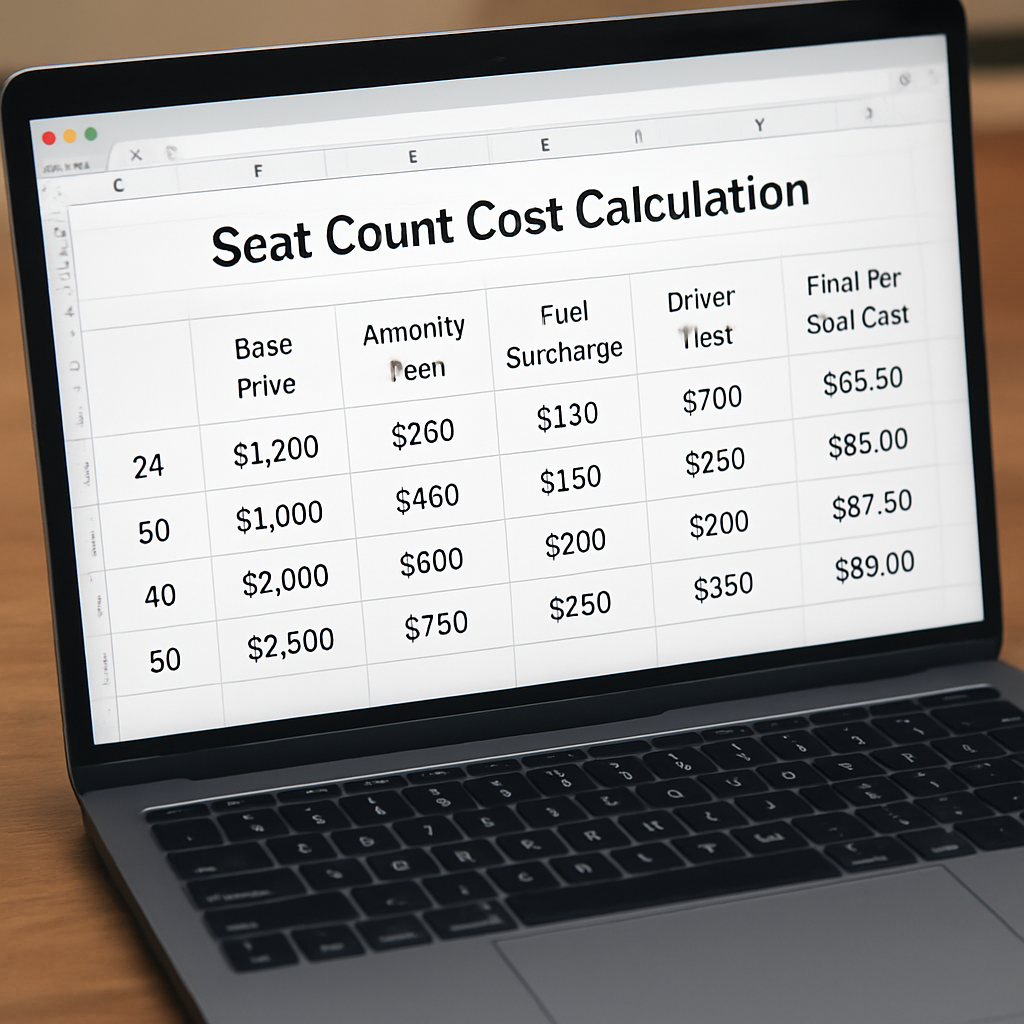
For example, a restroom adds €120, Wi‑Fi €60, and a wheelchair zone €80. Total extra €260. New total cost = €1,200 + €260 = €1,460. New per‑seat cost = €1,460 ÷ 32 ≈ €45.63.
3. Factor in distance and fuel
Most charter quotes include fuel for a set mileage. If you’re going beyond that, you’ll see a per‑kilometre charge. Let’s say the provider adds €0.25 per km after 300 km. A 450‑km round trip adds €37.50. Spread that across seats: €37.50 ÷ 32 ≈ €1.17 per seat.
So now you’re looking at roughly €46.80 per seat for a 450‑km journey with all the bells and whistles.
4. Don’t forget driver and service fees
Drivers aren’t free, and there’s often a small “service” fee for scheduling and paperwork. It might be a flat €100 plus €15 per driver hour. If you have a 6‑hour trip, that’s €190. Divide again: €190 ÷ 32 ≈ €5.94 per seat.
Adding that brings you to about €52.74 per seat. Not bad, considering you’ve accounted for everything.
So, what’s the takeaway? Take the total price, subtract the known extras, then distribute the remainder over the actual usable seats. That gives you a realistic per‑seat cost you can compare across providers.
5. Run a quick sanity check
Ask yourself: does the final per‑seat figure align with your budget per passenger? If you planned €45 per head and you’re seeing €53, you either need to trim amenities or look for a smaller bus.
Another trick is to calculate the total cost for the whole group and then add a 10 % contingency. That buffer covers unexpected taxes or last‑minute changes.
Finally, always request a written breakdown before you sign. A clear PDF lets you spot hidden line items – like “overnight parking” or “airport surcharge” – before they surprise you.
When you walk through these steps, you’ll know exactly how many seats a charter bus has, how much each seat truly costs, and whether the numbers make sense for your event, tour, or corporate roadshow.
Charter Bus Capacity Comparison Table
When you finally sit down with a provider, the first thing you’ll want is a quick visual of how the different bus classes stack up against each other.
That’s why we’ve pulled together a compact comparison table – think of it as the cheat sheet you keep on the back of your hand while you’re negotiating the final numbers.
Below the table you’ll find a short rundown of what each row really means for an event planner, a tour operator, or a corporate road‑show manager.
The key columns are Capacity, Typical Seat Count, Luggage Volume, Amenity Impact and Ideal Use‑Case – everything you need to answer the dreaded question, “how many seats does a charter bus have?” in a real‑world scenario.
Let’s walk through the numbers together, starting with the smallest option that still feels like a proper bus.
Mini‑bus (7‑16 seats) – perfect for VIP airport drops, bridal parties or a small school outing.
Because the cabin is compact, you get roughly 0.8 m³ of under‑floor luggage space and usually no restroom, which means the advertised seat count is the usable count.
If you need a wheelchair ramp, subtract three seats; otherwise you can count on every seat being available for passengers.
Mid‑size coach (25‑35 seats) – the sweet spot for day trips to Toledo, museum tours or a corporate training session that needs a coffee cart.
These coaches normally include a compact restroom that eats up two to three seats, and they offer about 1.5‑2 m³ of cargo space – enough for backpacks, a few suitcases or a small sound‑equipment case.
Add a Wi‑Fi kit and you’ll lose another seat or two to the equipment rack, so always ask the operator for the “post‑amenity” seat count.
Full‑size motorcoach (45‑70 seats) – built for long hauls, sports teams, concert crews or multi‑day pilgrimages.
Here the seat pitch drops from 30 inches in a 45‑seat layout to about 28 inches when you push the bus up to 70 seats, and you gain 3‑4 m³ of luggage volume.
A full‑size coach can sport a larger bathroom (costing four seats) or a galley, but those comforts are optional – the base seat count you see on the door is rarely the number you’ll actually use.
Accessibility is the wildcard across all classes – a PMR‑adapted zone typically removes three to five seats, and you should also plan a caregiver seat if needed.
Now that you’ve seen the raw figures, ask yourself: does the bus still have room for the extra suitcases, the coffee trolley, or that extra guest who always shows up late?
If the answer is no, you have three quick ways to fix it without blowing up your budget.
First, trim the amenity list – a portable restroom can be swapped for a nearby public facility if the journey is under four hours.
Second, add a second mini‑bus for oversized gear; that’s exactly what we did for a music‑festival crew that needed a 70‑seat coach plus a 12‑seat van for drums and lighting rigs.
Third, apply a 10‑15 % comfort buffer to the usable seat count; it’s a simple math step that saves you from cramped aisles and angry passengers.
Below the table you’ll see a quick checklist that turns these ideas into an actionable decision matrix you can print out and hand to any charter provider.
| Bus Class | Typical Seats (raw) | Usable Seats (after amenities) | Luggage Volume | Ideal Use‑Case |
|---|---|---|---|---|
| Mini‑bus (7‑16) | 12 | 12 – 9 (‑3 for wheelchair) | ≈0.8 m³ | VIP airport transfer, small wedding party |
| Mid‑size coach (25‑35) | 30 | 27 – 24 (‑3 restroom, ‑2 Wi‑Fi) | 1.5‑2 m³ | Day‑trip tours, corporate training |
| Full‑size motorcoach (45‑70) | 55 | 48 – 42 (‑4 bathroom, ‑3 PMR) | 3‑4 m³ | Long‑haul sports team, concert crew |
Take a look at the “Ideal Use‑Case” column – if you’re planning a wedding transfer for 12 guests, the mini‑bus row will instantly tell you that you have enough seats and luggage space without needing a restroom.
For a corporate roadshow of 30 people with laptops and a catering cart, the mid‑size coach row shows you’ll lose a couple of seats to the restroom but still end up with a comfortable 28‑30 usable seats.
And if you’re moving a sports team of 22 players plus equipment across the country, the full‑size motorcoach row makes clear why you’d opt for a 45‑seat layout with extra legroom rather than stuffing everyone into a 70‑seat bus.
The bottom line? The simple table gives you a snapshot, but the real magic happens when you match those numbers to your specific checklist – passengers, luggage, amenities and any accessibility needs.
When you’ve done that, answering “how many seats does a charter bus have” becomes as easy as reading the row that matches your scenario.
So, before you sign that contract, pull out this comparison, run the quick buffer calculation, and you’ll walk into the negotiation with confidence and a clear picture of exactly what you’re paying for.
Conclusion
By now you’ve seen how a simple seat‑count table turns the vague question “how many seats does a charter bus have” into a practical decision tool.
Whether you’re moving a wedding party, a corporate roadshow, or a sports team, the trick is the same: match the raw capacity to your actual checklist of passengers, luggage, and any amenities you can’t do without.
In our experience at Torres Bus, we always ask clients to subtract two‑three seats for a restroom and three‑five seats for a wheelchair zone before adding a 10‑15 % comfort buffer for trips over four hours.
That little math step saves you from the dreaded scramble on the day of travel and gives you confidence when you finally answer the headline question.
So, what’s the next move? Grab your passenger list, run the quick seat‑map calculator we showed you, and ask the charter provider for a written layout before you sign.
When the numbers line up, you’ll know exactly how many seats does a charter bus have for your event, and you’ll walk into the negotiation with peace of mind.
Need a hand tailoring the perfect bus size for your next outing? Get in touch with our team – we’ll map the numbers to the right vehicle so you can focus on the fun part of the journey.
FAQ
How many seats does a charter bus actually have?
It depends on the bus class. A minibuss can hold 7‑16 seats, a mid‑size coach usually offers 25‑35 seats, and a full‑size motorcoach ranges from 45‑70 seats. Those numbers are the raw, legal maximum printed on the vehicle door. In practice you’ll lose a few seats to amenities like a restroom or a wheelchair zone, so the usable count is often a bit lower.
What common features trim the seat count?
Restrooms are the biggest seat‑eaters – they typically knock out 2‑4 seats. A wheelchair‑accessible ramp and securement points subtract another 3‑5 seats. On‑board Wi‑Fi or an AV rack can steal 1‑2 more. Even a small galley or a coffee cart takes up space. Add these up and you’ll see why a 45‑seat coach might only give you 38‑40 usable seats.
Can I still fit everyone if I need a wheelchair‑friendly layout?
Yes, but you have to plan for the loss. A standard 45‑seat coach loses about four seats when a PMR zone is installed. If that leaves you short, consider a 55‑seat coach or add a 12‑seat minibuss for the extra guests and gear. Torres Bus often pairs a wheelchair‑adapted vehicle with a smaller companion bus to keep the whole party together.
How do I calculate the right bus size for a six‑hour trip?
Start with your headcount, then add 1‑2 drivers and any on‑board staff. Subtract seats taken by the restroom, wheelchair space, and any AV equipment. Finally, apply a 10‑15 % comfort buffer because long journeys need extra legroom and luggage space. For example, 40 passengers + 2 drivers = 42, minus 5 seats for amenities = 37, then add a 12 % buffer (≈4 seats) → aim for a 35‑seat coach.
Is there a standard comfort buffer I should use?
We recommend a 10 % buffer for day trips (under four hours) and a 15 % buffer for anything longer. The extra seats give people room to stretch, keep aisles clear for luggage, and make bathroom stops less chaotic. It also protects you against unexpected guests or extra equipment that shows up at the last minute.
What should I ask the charter provider before I sign?
Ask for a post‑amenity seat map that labels the restroom, wheelchair zone, and any AV gear. Verify the total luggage volume against your suitcase list. Confirm that the vehicle complies with Spain’s PMR regulations if you have reduced‑mobility passengers. Request a written cost breakdown that separates base price, amenity fees, fuel surcharge, and driver charges. Having all that on paper prevents surprise fees on the day of travel.